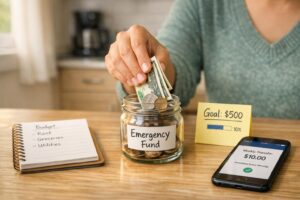

Building a financial safety net can feel like an impossible challenge when every dollar of your income is already spoken for. When living paycheck to paycheck, the advice to “save three to six months of expenses” often sounds disconnected from reality.
However, an emergency fund is not reserved exclusively for high earners. It is a fundamental financial tool designed precisely for moments when cash flow is tight. Creating a buffer against unexpected costs—such as medical bills, urgent car repairs, or sudden job loss—is entirely achievable, even on a strict budget, by using micro-saving strategies and structured cash flow management.
1. Redefining the Emergency Reserve Strategy
The primary obstacle for most small-budget savers is scale. Aiming for a $10,000 safety net right out of the gate creates psychological friction and leads to burnout.
To build momentum, break the goal into manageable, sequential phases:
- Phase 1: The Starter Buffer ($500 to $1,000)This initial cushion is designed to absorb everyday disruptions—a flat tire, an unexpected prescription, or an urgent home repair—without forcing you to rely on high-interest credit cards or high-cost loans.
- Phase 2: One Month of Core Living ExpensesOnce the starter buffer is secure, pivot toward covering essential baseline costs (housing, basic food, utilities, and essential transport) for one full month.
- Phase 3: The Full 3-to-6 Month Safety NetWith a solid foundation established, you can gradually extend your runway to cover extended periods of financial uncertainty.
2. Uncovering Invisible Cash Flow
When cash flow is constrained, finding money to save requires granular visibility into your daily transactions. You do not necessarily need a radical lifestyle change to find extra dollars; often, small adjustments across several categories yield meaningful results.
+------------------------+------------------------------------+--------------------------+
| Budget Category        | Low-Friction Adjustment Strategies | Estimated Monthly Impact |
+------------------------+------------------------------------+--------------------------+
| Recurring Subscriptions| Cancel unused streaming, apps, or  | $15 – $45                |
|                        | auto-renewing memberships          |                          |
+------------------------+------------------------------------+--------------------------+
| Utilities & Services   | Call providers to negotiate rates  | $20 – $60                |
|                        | or request loyalty discounts       |                          |
+------------------------+------------------------------------+--------------------------+
| Food & Grocery         | Swap brand names for generics and  | $40 – $100               |
|                        | plan meals around weekly sales     |                          |
+------------------------+------------------------------------+--------------------------+
Conducting a thorough audit of the last 60 days of bank statements often highlights unnoticed recurring micro-expenses. Diverting these small leaks directly into a separate account builds momentum without disrupting your core living standards.
3. The Power of Micro-Savings and Automation
Consistency matters far more than the size of individual contributions. Saving $5 or $10 every week continuously builds momentum and reinforces positive financial habits.
Automated Micro-Transfers
Relying on leftover funds at the end of the month rarely works because unallocated cash tends to be spent. Instead, set up an automatic transfer of a modest amount—such as $10—to trigger every payday. Because the money moves automatically, you adapt your spending to the remaining balance without extra effort.
Capitalizing on Windfalls and One-Time Inflows
Accelerate your progress by routing irregular or non-standard income straight to your emergency fund:
- Tax refunds or government adjustments
- Workplace bonuses or overtime pay
- Cash gifts or proceeds from selling unused household items
Allocating 50% to 80% of any unexpected cash inflow directly to your emergency buffer allows you to make major leaps forward without impacting your day-to-day budget.
4. Account Placement and Financial Protection
Where you store your emergency money is just as important as how you save it. To work effectively, your buffer must meet two conditions: high liquidity and strict separation from daily spending.
                           +-----------------------------------+
                           |    Monthly Payroll / Main Bank    |
                           +-----------------------------------+
                                             |
                                             |  Automated Payroll Direct Deposit
                                             v
                           +-----------------------------------+
                           | High-Yield Savings Account (HYSA) |
                           |  (Separate Bank / FDIC Insured)   |
                           +-----------------------------------+
                                             |
                                             |  Yields Interest / Remains Liquid
                                             v
                           +-----------------------------------+
                           | Financial Emergency Safety Shield |
                           +-----------------------------------+
High-Yield Savings Accounts (HYSA)
Keeping emergency funds in a standard checking account creates a temptation to spend them on daily purchases. Placing the money in a separate High-Yield Savings Account (HYSA) offers several practical benefits:
- Separation: Keeping the funds out of sight reduces impulse spending.
- Capital Preservation: FDIC or NCUA insurance guarantees account safety up to regulatory limits.
- Interest Accrual: HYSAs offer higher interest rates than traditional checking accounts, helping your balance compound over time.
5. Establishing Clear Rules for Capital Withdrawal
An emergency fund serves a single purpose: maintaining financial stability during genuine crises. Without clear guidelines, it is easy to deplete the fund on non-essential purchases.
Before withdrawing money from your fund, evaluate the situation using three key questions:
- Is it Urgent? Does this issue require immediate financial resolution, or can it wait until the next pay period?
- Is it Necessary? Is this expense essential for health, safety, shelter, or maintaining your income?
- Is it Unexpected? Was this cost truly unpredictable, or was it a predictable annual expense (such as vehicle registration or insurance premiums) that should be budgeted separately?
If an expense meets all three criteria, draw on your emergency fund with confidence—that is precisely why you built it. Once the crisis passes, adjust your budget to focus on replenishing the balance.
Long-Term Financial Resilience
Building an emergency fund on a tight budget requires patience, discipline, and a realistic approach. By starting with micro-contributions, automating transfers, and keeping your savings in a dedicated account, you gradually create a solid financial buffer. Over time, this cushion protects you from unexpected expenses, reduces financial stress, and provides lasting stability.